DELAMINATIONS: TABLET XII
Elizabeth T. Gray, Jr.
Armand Schwerner was interested in what could be found or placed in the gaps: the missing or indecipherable, the space that opens up inside a word that might mean “pig” or “goddess,” “power” or “damage.” So many liminal and unstable spaces, “ways out of closures,” “infinite interstices” (135). Is the tablet real or fictional, if fictional, how fictional? Where, if anywhere, does the fictional Scholar/Translator seem to know what he’s talking about? So much is possible because so much is unreliable.
I, also a scholar/translator, wanted to know where all this came from, what Schwerner was fascinated by at the outset.[1] My excavation is ongoing, but, as an illustrative example, let’s take a quick look at the stratigraphy of “Tablet XII,” identifying the layers and the veins of possibility that opened out for Schwerner.
The last twenty-six lines of the poem look, surely, like transliterated something:
ud an-ki-ta tab-gi-na til-a-ta-eš-a
Dingir ama Dingir Inanna-ge e-ne ba-sig-e-ne
ud ki-ga-gae-de ki-du-dua-ta
ud giš-ha-har-an-ki-a mûn-gi-na-eš-a-ba… (37)
and that transliterated something is set to music on the last two pages of “Tablet XII.” Our companionable Scholar/Translator informs us that this tablet, “K A R 1, 4,” rendered into English by the Sumermusicologist F. W. Galpin, Litt. D, F.L.S., Canon Emeritus of Chelmsford Cathedral and Hon. Freeman of the Worshipful Company of Musicians, is “the first musically notated chant written in human history” the “oldest music we have.” Would you believe him?
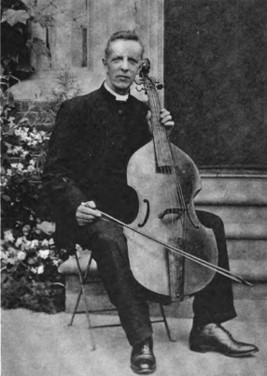
Canon Francis William Galpin (1858-1945), author of the text referred to by our Scholar/Translator, is actually a real person:
And Canon Galpin did study and create a transliterated version of KAR 4, also known as VAT.9037,[2] which indeed is held in the Vorderasiatisches Museum (Museum of the Ancient Near East), part of the Staatliche Museen in Berlin. It is a Sumerian hymn on the “Creation of Man/Humankind.” Here is the original text:
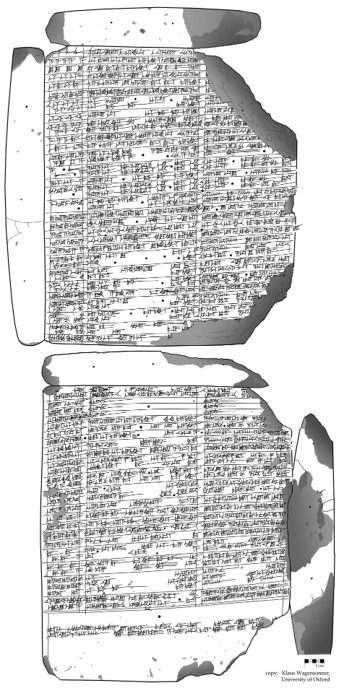
As you can see, Canon Galpin is correct that the center column is in Sumerian and the right-hand column is an Akkadian line-by-line translation, but he mis-read the left-hand column completely. The cuneiform signs in the left-hand column are scribal syllabary/sign exercise and have nothing to do with musical annotation. So, as for the musical score (the Scholar/Translator asserts it’s Galpin’s, it may be Schwerner’s), it is generated by a historical mis-reading, set to modern music, and so perhaps not “the oldest music we have” (35).
As for the transliteration of lines 1-26 of the “Creation of Mankind,” I was not able to access the good Canon’s transliteration, but it appears that Schwerner’s transcription of it alters some of the words by oversight or for sonic or visual design: the “d” that begins “Dingir,” for example, is not a spoken letter in Sumerian, but a determinative, an unspoken written sign that here signifies that the name that follows is a god or goddess.[3] Today that would be transliterated as a superscript “d” preceding the word: dEnlil, dEnki.
But I digress.
There are so many fissures available here. All of which were available as a field for Schwerner’s exploration. What does he do? He offers a translation of the text. Here are lines 12-20 of KAR 4 (the gods are speaking):[4]
“After all the plans of heaven and earth have been made firm,
the canals and ditches have been placed in order,
the banks of Tigris and Euphrates
have been placed
what will you change
what shall you fashion?
Aruna, great gods,
what will you change
what will you fashion?”
The text is known as “The Creation of Man” or “The Creation of Humankind,” and, in this poem, Schwerner’s version reflects his understanding, internalization, and re-creation of the actual Sumerian original, without being a line-by-line translation[5]:
when earth was laid in its place
and heavens fitted
when straight-line stream and canal ran
when Tigris filled the bed
and Euphrates filled the bed…
[the gods]
sat in a high place
and alongside them
the gods Anunnaki of the earth
—so it went
and now
what would you have us do now?
what more do you ask for? (38)
What is Tablet XII? An analysis by a fictional Scholar/Translator of an actual analysis by an historical scholar/translator of an actual bilingual Sumerian-Akkadian tablet that he mis-read and misunderstood, set as a chant to a musical score built from that mis-reading by a brilliant poet.
Elizabeth T. Gray Jr. is a poet, translator, critic, and corporate consultant. Poetry collections include Salient (New Directions), and After the Operation and Series | India (Four Way Books). Her translations from classical and contemporary Persian include Let Us Believe in the Beginning of the Cold Season, selected poems of Forough Farrokhzad (New Directions, Finalist for the PEN Prize for Poetry in Translation 2023) and The Green Sea of Heaven: Eighty Ghazals from the Diwan of Hafiz: 30th Anniversary Edition (Monkfish Publishing). She serves on the Boards of World Poetry, Kimbilio Fiction, Flood Editions, Friends of Writers, The Beloit Poetry Journal Foundation, and Human Rights and Democracy in Iran. She holds a BA and JD from Harvard University and an MFA from Warren Wilson College. She was the founding CEO of Conflict Management, Inc. and Alliance Management Partners, boutique corporate consulting firms. www.etgrayjr.com
[1] In the Gingerich interviews Schwerner mentions, several times, the fateful afternoon in Columbia’s Butler Library he found his arm resting on a “large format edition of Samuel Noah Kramer's translation and transliteration from the Sumerian. I interpreted my experience as an omen. I have never forgotten the power of that initial charge” (Ed Foster, Talisman Interview, 1999). The actual book remains unidentified but Samuel Noah Kramer (1897-1990) was the founding father of Sumerian Studies. Through the 1950s and early 1960s Kramer, and also the Danish Assyriologist Thorkild Jacobsen (1904-1993), produced extensive scholarly work on newly discovered and recently assembled tablet texts.
[2] The transliteration of KAR 4/VAT.9307, using current standard transliteration format for Sumerian, can be found in the Electronic Babylonian Library, here: https://www.ebl.lmu.de/library/VAT.9307
[3]The myriad effects available to Schwerner through the use of such “determinatives” (actual or invented) is highly visible in Tablets XXVI-XXVII.
[4] The complete literal English translation of the tablet, as well as a line-by-line transliteration, by current real-life scholar/translators can be found at https://seal.huji.ac.il/node/1600. I have omitted here the variations between translated Sumerian and Akkadian, these can be found at the link.
[5] Of course, I, too, like our Scholar/Translator, have resorted to bracketed insertions and an ellipsis, willful insertions in the interest of time and space.
Elizabeth T. Gray, Jr.
Armand Schwerner was interested in what could be found or placed in the gaps: the missing or indecipherable, the space that opens up inside a word that might mean “pig” or “goddess,” “power” or “damage.” So many liminal and unstable spaces, “ways out of closures,” “infinite interstices” (135). Is the tablet real or fictional, if fictional, how fictional? Where, if anywhere, does the fictional Scholar/Translator seem to know what he’s talking about? So much is possible because so much is unreliable.
I, also a scholar/translator, wanted to know where all this came from, what Schwerner was fascinated by at the outset.[1] My excavation is ongoing, but, as an illustrative example, let’s take a quick look at the stratigraphy of “Tablet XII,” identifying the layers and the veins of possibility that opened out for Schwerner.
The last twenty-six lines of the poem look, surely, like transliterated something:
ud an-ki-ta tab-gi-na til-a-ta-eš-a
Dingir ama Dingir Inanna-ge e-ne ba-sig-e-ne
ud ki-ga-gae-de ki-du-dua-ta
ud giš-ha-har-an-ki-a mûn-gi-na-eš-a-ba… (37)
and that transliterated something is set to music on the last two pages of “Tablet XII.” Our companionable Scholar/Translator informs us that this tablet, “K A R 1, 4,” rendered into English by the Sumermusicologist F. W. Galpin, Litt. D, F.L.S., Canon Emeritus of Chelmsford Cathedral and Hon. Freeman of the Worshipful Company of Musicians, is “the first musically notated chant written in human history” the “oldest music we have.” Would you believe him?
Canon Francis William Galpin (1858-1945), author of the text referred to by our Scholar/Translator, is actually a real person:
And Canon Galpin did study and create a transliterated version of KAR 4, also known as VAT.9037,[2] which indeed is held in the Vorderasiatisches Museum (Museum of the Ancient Near East), part of the Staatliche Museen in Berlin. It is a Sumerian hymn on the “Creation of Man/Humankind.” Here is the original text:
As you can see, Canon Galpin is correct that the center column is in Sumerian and the right-hand column is an Akkadian line-by-line translation, but he mis-read the left-hand column completely. The cuneiform signs in the left-hand column are scribal syllabary/sign exercise and have nothing to do with musical annotation. So, as for the musical score (the Scholar/Translator asserts it’s Galpin’s, it may be Schwerner’s), it is generated by a historical mis-reading, set to modern music, and so perhaps not “the oldest music we have” (35).
As for the transliteration of lines 1-26 of the “Creation of Mankind,” I was not able to access the good Canon’s transliteration, but it appears that Schwerner’s transcription of it alters some of the words by oversight or for sonic or visual design: the “d” that begins “Dingir,” for example, is not a spoken letter in Sumerian, but a determinative, an unspoken written sign that here signifies that the name that follows is a god or goddess.[3] Today that would be transliterated as a superscript “d” preceding the word: dEnlil, dEnki.
But I digress.
There are so many fissures available here. All of which were available as a field for Schwerner’s exploration. What does he do? He offers a translation of the text. Here are lines 12-20 of KAR 4 (the gods are speaking):[4]
“After all the plans of heaven and earth have been made firm,
the canals and ditches have been placed in order,
the banks of Tigris and Euphrates
have been placed
what will you change
what shall you fashion?
Aruna, great gods,
what will you change
what will you fashion?”
The text is known as “The Creation of Man” or “The Creation of Humankind,” and, in this poem, Schwerner’s version reflects his understanding, internalization, and re-creation of the actual Sumerian original, without being a line-by-line translation[5]:
when earth was laid in its place
and heavens fitted
when straight-line stream and canal ran
when Tigris filled the bed
and Euphrates filled the bed…
[the gods]
sat in a high place
and alongside them
the gods Anunnaki of the earth
—so it went
and now
what would you have us do now?
what more do you ask for? (38)
What is Tablet XII? An analysis by a fictional Scholar/Translator of an actual analysis by an historical scholar/translator of an actual bilingual Sumerian-Akkadian tablet that he mis-read and misunderstood, set as a chant to a musical score built from that mis-reading by a brilliant poet.
Elizabeth T. Gray Jr. is a poet, translator, critic, and corporate consultant. Poetry collections include Salient (New Directions), and After the Operation and Series | India (Four Way Books). Her translations from classical and contemporary Persian include Let Us Believe in the Beginning of the Cold Season, selected poems of Forough Farrokhzad (New Directions, Finalist for the PEN Prize for Poetry in Translation 2023) and The Green Sea of Heaven: Eighty Ghazals from the Diwan of Hafiz: 30th Anniversary Edition (Monkfish Publishing). She serves on the Boards of World Poetry, Kimbilio Fiction, Flood Editions, Friends of Writers, The Beloit Poetry Journal Foundation, and Human Rights and Democracy in Iran. She holds a BA and JD from Harvard University and an MFA from Warren Wilson College. She was the founding CEO of Conflict Management, Inc. and Alliance Management Partners, boutique corporate consulting firms. www.etgrayjr.com
[1] In the Gingerich interviews Schwerner mentions, several times, the fateful afternoon in Columbia’s Butler Library he found his arm resting on a “large format edition of Samuel Noah Kramer's translation and transliteration from the Sumerian. I interpreted my experience as an omen. I have never forgotten the power of that initial charge” (Ed Foster, Talisman Interview, 1999). The actual book remains unidentified but Samuel Noah Kramer (1897-1990) was the founding father of Sumerian Studies. Through the 1950s and early 1960s Kramer, and also the Danish Assyriologist Thorkild Jacobsen (1904-1993), produced extensive scholarly work on newly discovered and recently assembled tablet texts.
[2] The transliteration of KAR 4/VAT.9307, using current standard transliteration format for Sumerian, can be found in the Electronic Babylonian Library, here: https://www.ebl.lmu.de/library/VAT.9307
[3]The myriad effects available to Schwerner through the use of such “determinatives” (actual or invented) is highly visible in Tablets XXVI-XXVII.
[4] The complete literal English translation of the tablet, as well as a line-by-line transliteration, by current real-life scholar/translators can be found at https://seal.huji.ac.il/node/1600. I have omitted here the variations between translated Sumerian and Akkadian, these can be found at the link.
[5] Of course, I, too, like our Scholar/Translator, have resorted to bracketed insertions and an ellipsis, willful insertions in the interest of time and space.